CM Punjab Rehmat Card 2026: Complete Guide to Registration, Eligibility, and Benefits
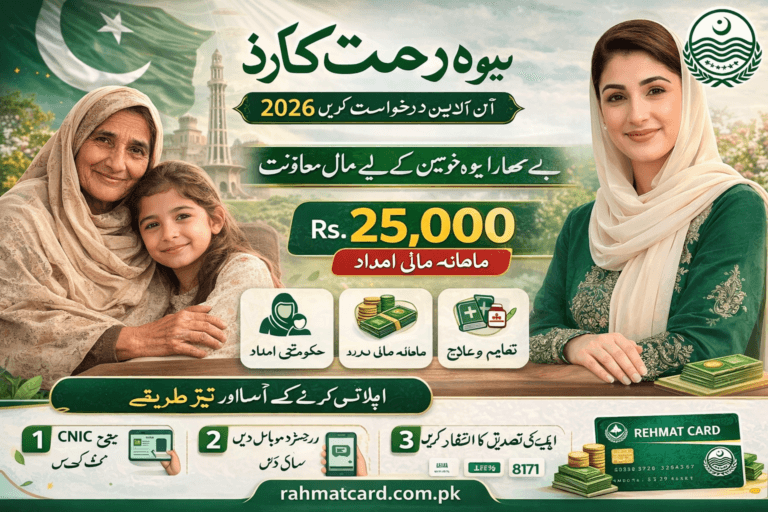
The CM Punjab Rehmat Card is a government welfare program that provides direct financial assistance to widows and orphan children across Punjab. Approved by Chief Minister Maryam Nawaz Sharif in March 2026, it gives eligible widows up to Rs. 100,000 and Rs. 25,000 per orphan child — distributed through a secure digital card system managed by the Zakat & Ushr Department.
The program covers Rehmat Card registration, eligibility verification through PSER, payment via HBL Konnect or UBL Omni, and status tracking online or via SMS 8171. It runs alongside other Punjab welfare initiatives like the Himmat Card and Kissan Card. This guide covers everything: what the scheme is, who qualifies, required documents, how to apply online or offline, how to check your application status, and how to stay safe from scams.
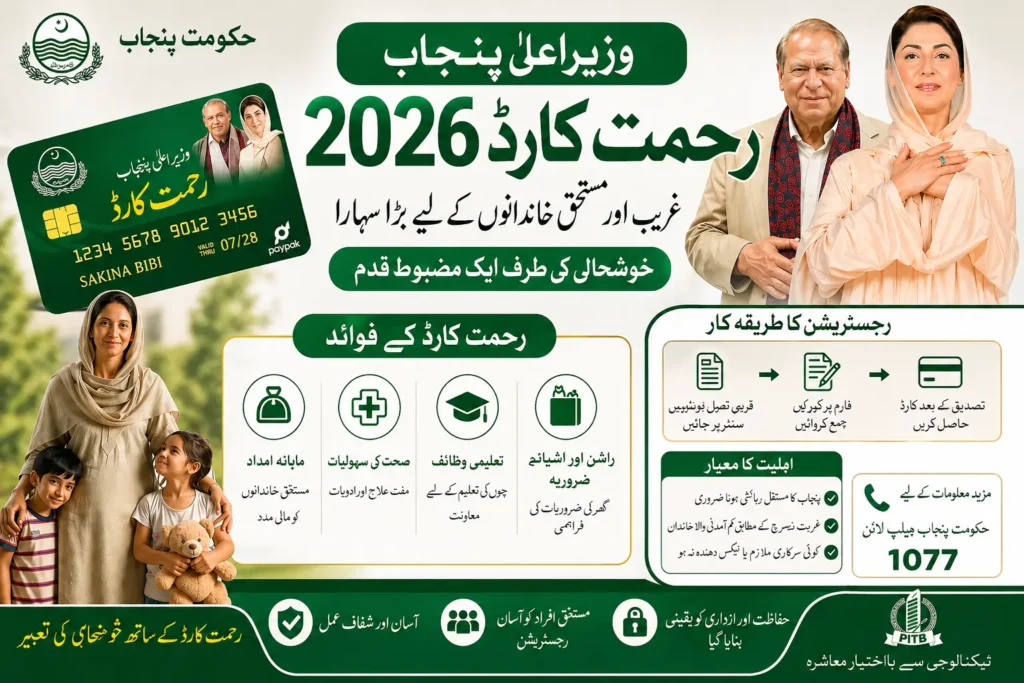
What is the CM Punjab Rehmat Card 2026?
The CM Punjab Rehmat Card 2026 is an official welfare program launched by the Government of Punjab under Chief Minister Maryam Nawaz Sharif. It is specifically designed to support widows (Bewa) and double-parent orphans (Yateem) who face financial hardship after losing their primary breadwinner.
Unlike programs that provide small monthly payments, the Rehmat Card focuses on economic empowerment. It provides a significant one-time financial grant so families can rebuild — start a small business, cover school fees, or manage basic household expenses without depending on others.
The program is administered through the Zakat & Ushr Department. Payments are made via digital wallet or bank agents, cutting out middlemen entirely. The official registration portal is rahmatcard.punjab.gov.pk
Objectives and Scope of the Program
The program has three core objectives.
First, financial assistance — provide Zakat-deserving widows and parentless orphans with real monetary support. Second, economic empowerment — help families achieve self-reliance and social dignity instead of dependence on charity. Third, transparency — ensure merit-based, fair utilization of Zakat Funds through digital verification systems.
The scope covers all districts of Punjab, from Attock to Rahim Yar Khan. In the first phase, over 50,000 households are expected to receive support shortly after Eid 2026. Budget allocation to District Zakat Committees is population-based, and final beneficiary selection is made through the Proxy Means Test (PMT) of the Punjab Socio Economic Registry (PSER).
Why the Government Introduced the Bewa Support Card
Widows are among the most financially vulnerable groups in Punjab. After losing a husband, many women have no stable income, no savings, and no support system. Orphan children face compounding challenges — financial pressure often forces them out of school early.
Inflation has made this worse. Rising food, healthcare, and education costs hit low-income families hardest. The Bewa Sahara Card — another name used for the Rehmat Card — was introduced to address this gap directly. State funds reach families without delay or corrupt middlemen taking a share along the way.
The government’s approach here is different from traditional welfare. Instead of waiting for people to seek help, the state actively identifies and assists those who have lost their primary financial support through the PSER database and NADRA records.
Key Benefits and Financial Assistance
The Rehmat Card 2026 offers one of the highest direct grants in the history of Punjab welfare schemes.
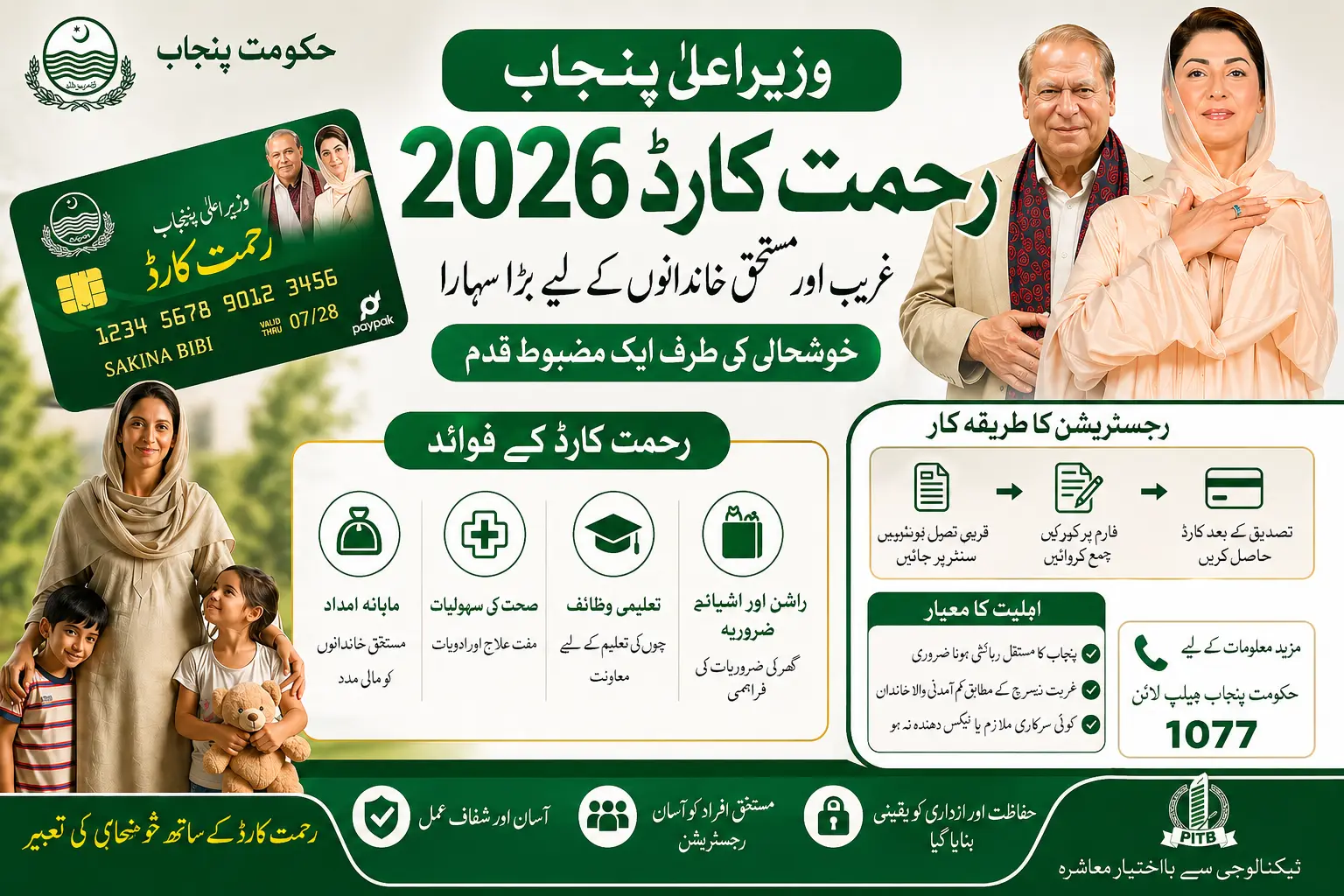
Eligible widows receive Rs. 100,000 as a one-time grant. Each orphan child in the family receives Rs. 25,000. For a widow with two children, total assistance reaches Rs. 150,000. Education support in the form of a monthly stipend is also included for students.
Payments are transferred directly via HBL Konnect or UBL Omni — no cash handling, no agents. The system is built on Islamic banking and Sharia-compliant finance principles since the funds come from Zakat.
Beyond cash, the program provides educational support for Yateem children so they stay in school. It also gives widows startup capital to begin small home-based work, creating long-term income rather than short-term relief. Families gain priority access to linked government assistance programs and reduce dependence on informal charity or loans.
The government’s stated goal is financial capital — not a handout — that helps widows become self-sufficient and gives orphan children a real chance at education and a better future.
Eligibility Criteria
Basic Requirements
To qualify for the CM Punjab Rehmat Card, applicants must meet all of the following conditions.
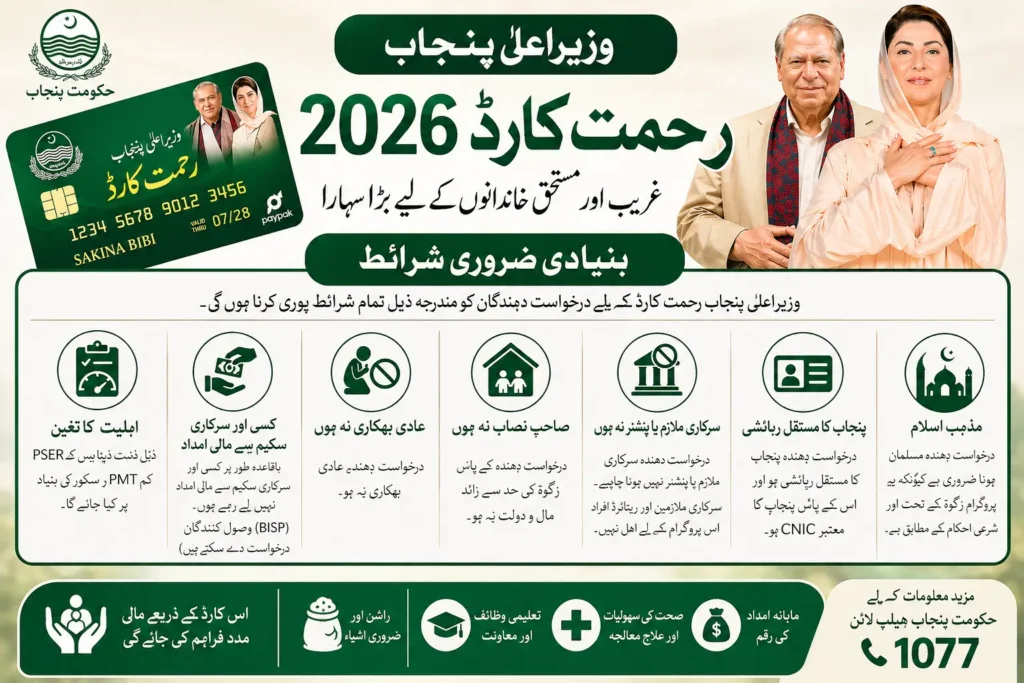
| # | Condition | Details |
|---|---|---|
| 1 | Muslim | Program Zakat funds distribute karta hai jo Shariah ke tehat governed hain |
| 2 | Punjab Resident | Valid CNIC hona zaroori hai jis mein Punjab domicile show ho |
| 3 | Not Govt Servant / Pensioner | Sarkari mulazim aur retire shuda afraad eligible nahi hain |
| 4 | Not Sahib-e-Nisab | Applicant ke paas Zakat threshold se zyada wealth nahi honi chahiye |
| 5 | Not a Habitual Beggar | Professional bhikari program ke rules ke tehat eligible nahi hain |
| 6 | No Other Punjab Scheme | Kisi aur Punjab scheme se assistance lene wale generally eligible nahi — BISP recipients portal se check karein |
| 7 | Low PMT Score | Eligibility PSER database ke zariye Proxy Means Test se confirm hoti hai |
Priority Groups (Widows and Orphan Children)
Two groups receive priority under the program.
Widows are women who have lost their husbands and are registered as “Widow” in the NADRA database. The CNIC must reflect the widow status. If NADRA records still show “Married,” the application will be rejected. Visit a NADRA office to update your status before applying. Widowed mothers with dependent children receive the highest priority in final selection.
Orphan children are those who have lost both parents — called double-parent orphans or parentless children. A valid B-Form issued by NADRA is required. Dependent children under 18 generally qualify for the per-child grant of Rs. 25,000. Double-parent orphans who have lost both parents are eligible for Rs. 100,000 — the same grant level as widows — not just the per-child amount.
Required Documents Checklist
Prepare these before you start the application process.
| # | Document | Details |
|---|---|---|
| 1 | Original CNIC | Updated hona chahiye — widows ke liye widow status show ho |
| 2 | Death Certificate | Shohar ka — NADRA ya Union Council se verified |
| 3 | B-Form | Har eligible bache ka — NADRA se jari shuda |
| 4 | Mobile Number | Active ho aur applicant ke apne CNIC par registered ho |
| 5 | Proof of Residence | Punjab domicile ka saboot zaroori hai |
| 6 | Household Information | Family size aur income details — basic ghar ki maloomat |
Having all documents ready before you start saves time and prevents rejection. Missing or incorrect documents are the top reason applications are delayed or refused. If your CNIC still shows “Married,” do not apply yet — update your status at a NADRA office first.
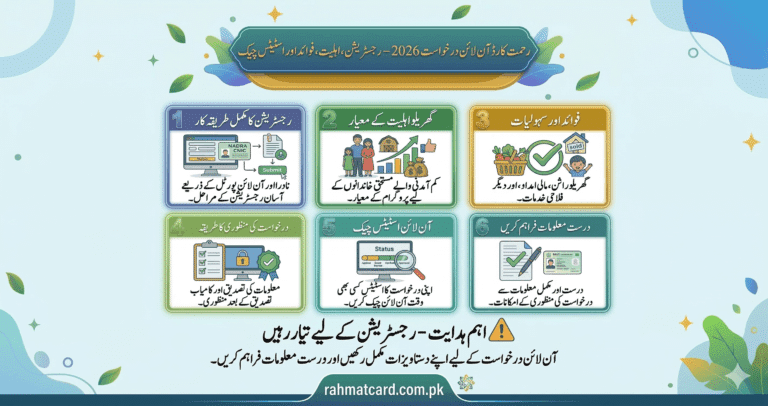
How to Apply for the Rehmat Card
There are four ways to register for the Rehmat Card. Choose whichever is most accessible for your situation.
Online Web Portal Registration
Visit the official portal at rahmatcard.punjab.gov.pk. This is the fastest method if you have internet access. Enter your CNIC number, fill in household details, and upload required documents. The system automatically checks your data against government databases including PSER and NADRA. You will receive a tracking ID to monitor your application status.
Mobile Application
A dedicated Mobile App for the Rehmat Card is available through the Zakat & Ushr Department. Download it from the official Punjab government app stores. The app lets you apply, track status, and receive notifications without visiting any office. It is designed for applicants with limited mobility or those living far from district offices.
Offline Registration (Zakat Offices & Call Centers)
If you do not have internet access, two offline options are available.
Call Helpline 1077 to get guidance and assistance with registration. Support agents will walk you through the process and direct you to your nearest registration center.
You can also visit your District Zakat & Ushr Office in person with your documents. Staff will assist with manual registration and document verification. This option is available across all districts of Punjab.
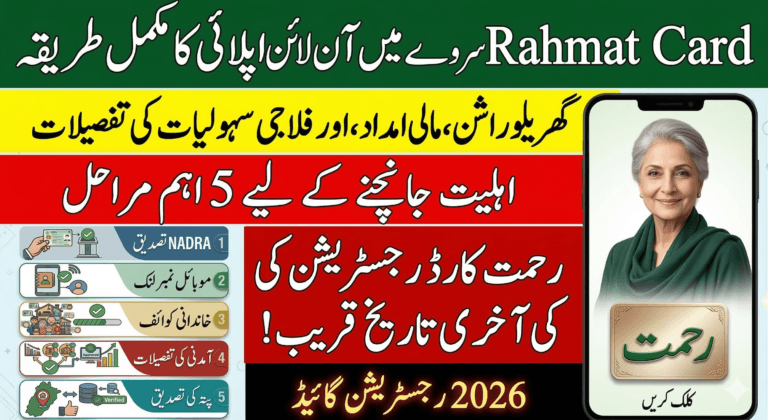
Step-by-Step Application Process
Gather Documents
CNIC, death certificate, B-Forms, aur registered mobile number ready karein.
Visit Portal or Office
rahmatcard.punjab.gov.pk par jayein ya apne qareeb tareen District Zakat & Ushr Office jayein.
Fill Application Form
Family size, income level, aur dependent children ki accurate details bharein. Galat maloomat application reject karwa sakti hai.
Biometric Verification
Designated center par ja kar apna thumbprint dein — identity confirm hogi.
PSER Verification
Punjab Socio Economic Registry aapka data national database se verify karega — intezaar karein.
SMS Confirmation
Approve hone par official government service ki taraf se SMS ayega — payment instructions saath hongi.
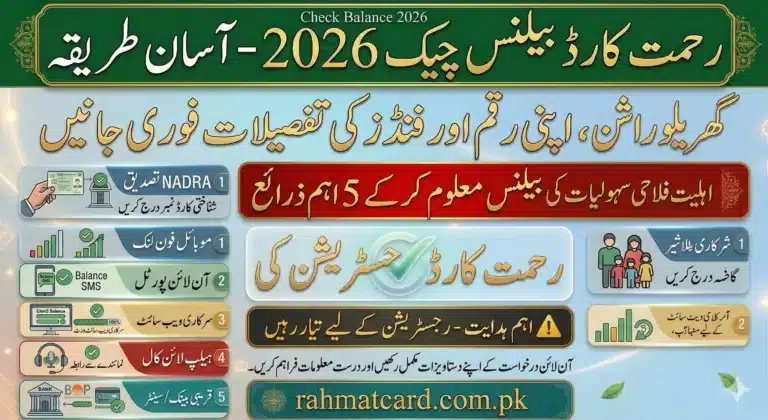
How to Check Application Status
Online Status Check Portal
Go to rahmatcard.punjab.gov.pk, enter your CNIC number, and click check. Your current application status appears immediately. The portal is available 24 hours and works from any device with internet access.
SMS Verification (8171)
Send your CNIC number to 8171. You will receive a reply with your eligibility and application status. This works without internet access and is reachable from any mobile network across Punjab. It is the easiest option for applicants in rural areas or those without smartphones.
Understanding Application Status Meanings
Approved means you will receive financial support. Wait for the payment notification via SMS.
Pending means verification is still in process. Check again after a few days.
Rejected means the eligibility criteria were not met. Read the reason carefully. In most cases, it is an incorrect CNIC status or outdated NADRA records. Fix the issue and re-apply, or visit your District Zakat & Ushr office to file an appeal.
Most rejections are due to incorrect CNIC data or NADRA records that have not been updated. Fix your data at NADRA first, then re-apply.
The Role of PSER Survey and Digital Transparency
The Punjab Socio Economic Registry (PSER) is the backbone of the entire selection process. Without a record in the PSER database, your application cannot move forward.
PSER collects household-level socio-economic data across all districts of Punjab. It calculates a Proxy Means Test (PMT) score for each family. This score measures actual financial need based on verified data — not self-reporting. The score feeds into the Rehmat Card selection system, and beneficiaries are chosen in order of need.
If a PSER survey team visits your home, give honest information. The PMT score determines your rank in the beneficiary list. Providing false data leads to disqualification and potential legal action.
The digital system ensures full transparency. Fund transfers are direct. Application status is trackable online. There is no third-party involvement at any step. This No Middleman approach is central to how the program works — every rupee is meant to reach the rightful beneficiary without anyone taking a cut.
Budget for each district is allocated by District Zakat Committees based on population, and final selection is made purely on PMT scores. This removes human discretion from the process and ensures meritocracy.
Important Tips and Safety Measures
Common Mistakes to Avoid
The most common mistake is an outdated CNIC status. If NADRA shows “Married” instead of “Widow,” your application will be rejected immediately. Update your status at a NADRA office before you apply.
Filling in the form incompletely is the second most common problem. Every field must be filled in accurately. Missing information causes delays or outright rejection.
Submitting unclear or fake documents leads to permanent disqualification. Only submit genuine, legible originals.
Many applicants miss SMS updates because their registered number is inactive or belongs to someone else. Keep your registered mobile number active throughout the application process.
Applying through unofficial agents is a serious mistake. Agents who claim to speed up your application are not telling the truth. They take your money and may also compromise your personal data.
Avoiding Scams
Rehmat Card registration is 100% free. No payment is required at any step.
No government official will ask for processing fees or advance tax. If someone calls you asking for money to approve your card, they are running a scam. Never share your CNIC number on WhatsApp with unknown contacts. Do not use unofficial websites that claim to offer fast or guaranteed registration. Ignore messages that promise quick approval in exchange for payment.
Only use the official portal at rahmatcard.punjab.gov.pk, the official Zakat & Ushr mobile app, Helpline 1077, or your local District Zakat office. These are the only legitimate channels.
Integration with Other Welfare Programs
The Rehmat Card is part of Punjab’s broader social protection network. The Punjab government is building a unified digital welfare system that connects multiple schemes so deserving families receive all the support they qualify for through a single interface.
The Himmat Card supports persons with disabilities. The Kissan Card supports farmers. BISP — the Benazir Income Support Programme — is a federal scheme that some Rehmat Card applicants may also qualify for. The Aghosh Program supports maternal and child health. Families that qualify for multiple programs will receive all applicable benefits. The system identifies this automatically using shared databases.
BISP recipients can still apply for the Rehmat Card. The portal checks eligibility independently and confirms based on PMT scores. Priority goes to those not already receiving major support, but extremely poor families often qualify for both.
Frequently Asked Questions (FAQs)
Is the Rehmat Card only for residents of Lahore?
No. It covers all districts of Punjab, from Attock to Rahim Yar Khan. Any widow or orphan with a valid Punjab CNIC and domicile can apply.
When will payments be released?
Distribution for the first phase of 50,000 families is expected shortly after Eid 2026. Approved applicants will receive an SMS with their payment date.
Can I apply if I already receive BISP money?
Yes, you can apply. Priority goes to those not receiving major benefits from other schemes, but extremely poor families may still qualify. Check your eligibility on the portal.
How will I receive the money?
Once approved, funds are transferred to your digital wallet and can be withdrawn through HBL Konnect or UBL Omni agents.
What if my application is rejected?
Check the reason. Most rejections are CNIC or NADRA data issues. Fix the record at NADRA and re-apply, or visit your District Zakat office to file an appeal.
Is there an age limit for orphan children?
The additional per-child grant generally applies to dependent children under 18 years of age.
What if I do not have a NADRA death certificate?
You must obtain a computerized death certificate from NADRA or Union Council before applying. Applications without a verified death certificate will not be processed.
Is the application process free?
Yes. Registration is completely free. Anyone asking for money to register your application is running a scam.
What does double-parent orphan mean?
A double-parent orphan is a child who has lost both parents. These children receive Rs. 100,000 under the program — the same as widows — not just the Rs. 25,000 per-child amount.
Can a widow with no children apply?
Yes. Widows without children are still eligible for the Rs. 100,000 base grant, provided they meet all other eligibility criteria.
What is the official registration portal?
The official portal is rahmatcard.punjab.gov.pk. Registration will open after the official program launch is announced by the Punjab Government.
Conclusion
The CM Punjab Rehmat Card 2026 gives eligible widows up to Rs. 100,000 and Rs. 25,000 per orphan child through a digital, transparent system run by the Zakat & Ushr Department. The program targets Zakat-deserving families identified through PSER and selected via Proxy Means Test — ensuring the money reaches those who need it most, without middlemen.
To benefit from Rehmat Card registration 2026, start by updating your CNIC status at NADRA. Gather your documents — CNIC, death certificate, B-Forms — and apply through rahmatcard.punjab.gov.pk, the dedicated mobile app, Helpline 1077, or your nearest Zakat office. Check your status through the portal or by sending your CNIC to 8171.
The process is free, digital, and built without middlemen. If you know a widow or orphan in your neighborhood who qualifies, help them register. Many deserving families miss out simply because they do not know the process exists or how it works. A small effort today can secure long-term financial support for families who have already faced enough hardship.